What changes in 3.2.1, where insider-threat training goes, and how DIB organizations can prepare
A defense contractor has an annual security awareness course, an insider-threat briefing, and completion records for its employees. That is a useful starting point for a transition to NIST SP 800-171 Revision 3. The next step is to examine what those activities actually cover, when they occur, and how the organization keeps them current.
Revision 3 makes the training lifecycle more explicit. It also changes the organization of the Awareness and Training family in a way that is easy to misread: 03.02.03 is withdrawn as a separate requirement, but insider-threat training remains part of 03.02.01.
For organizations in the Defense Industrial Base (DIB), the practical opportunity is to build on existing training while closing specific gaps. A useful transition preserves effective material, connects training to changes in the working environment, and gives employees clear instructions for recognizing and reporting concerns.
Start with the correct requirement mapping
Revision 2 requirement 3.2.1 addresses awareness of security risks and the applicable policies, standards, and procedures for organizational systems. It expressly includes managers, system administrators, and users. Revision 2 requirement 3.2.3 separately addresses training to recognize and report potential insider-threat indicators.
In Revision 3, 03.02.01 is titled Literacy Training and Awareness. It combines the general literacy requirement with insider-threat training and expressly includes social engineering and social mining. The separate 03.02.03 entry directs readers to 03.02.01.
Figure 1 shows why a transition review should include both Revision 2 requirements. Comparing only 3.2.1 to 03.02.01 would miss part of the existing program that should be carried forward.
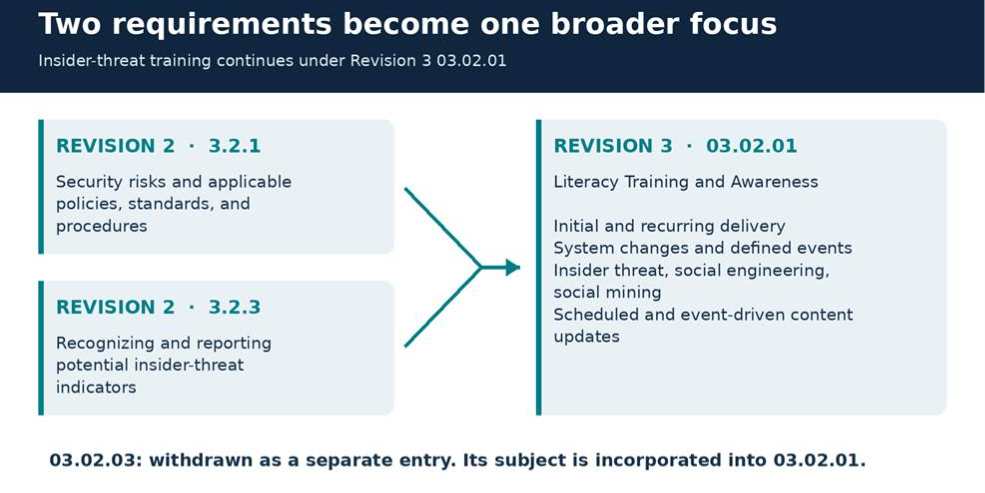
Figure 1. Revision 2 awareness and insider-threat requirements converge in Revision 3 literacy training. Withdrawal of the separate number does not remove the subject.
Role-based training remains a separate subject under Revision 3 03.02.02. A general awareness course should therefore be reviewed alongside the training people need for their assigned security duties. Combining course delivery may be convenient, but the organization still needs to account for the distinct requirements.
What remains familiar
The underlying purpose remains recognizable: people need to understand security risks and know what to do in their working environment.
For a manufacturer, useful examples might involve production drawings, approved file-transfer methods, visitors near engineering workstations, or requests from unfamiliar suppliers. For an engineering services firm, examples could focus on collaboration platforms, remote work, and exchanges with prime contractors.
A practical transition review should preserve this connection to actual work. A polished commercial course may explain common threats effectively, while a short organizational supplement explains the approved reporting channel, the handling process for controlled unclassified information (CUI), and the mistakes employees are most likely to encounter locally.
Managers and technical staff should participate in the review. Ask whether the examples reflect decisions they actually make. Training that tells employees to contact security is more useful when it also explains how to reach security, what information to provide, and what to do while waiting for assistance.
Existing insider-threat material can also remain valuable. Review it for accuracy, respectful language, and practical reporting instructions before incorporating it into the updated curriculum. Treat a potential indicator as a reason to report a concern through established channels, rather than an invitation for employees to investigate colleagues or draw conclusions about intent.
What Revision 3 makes more explicit
Revision 3 03.02.01 specifies initial and recurring training, training when required by system changes or defined events, and scheduled and event-driven content updates. It also expressly covers recognizing and reporting insider-threat, social-engineering, and social-mining indicators. Four organization-defined parameters address the two frequencies and two sets of triggering events.
These details suggest two separate management questions: When do people need training, and when does the training itself need to change? Figure 2 separates those activities.
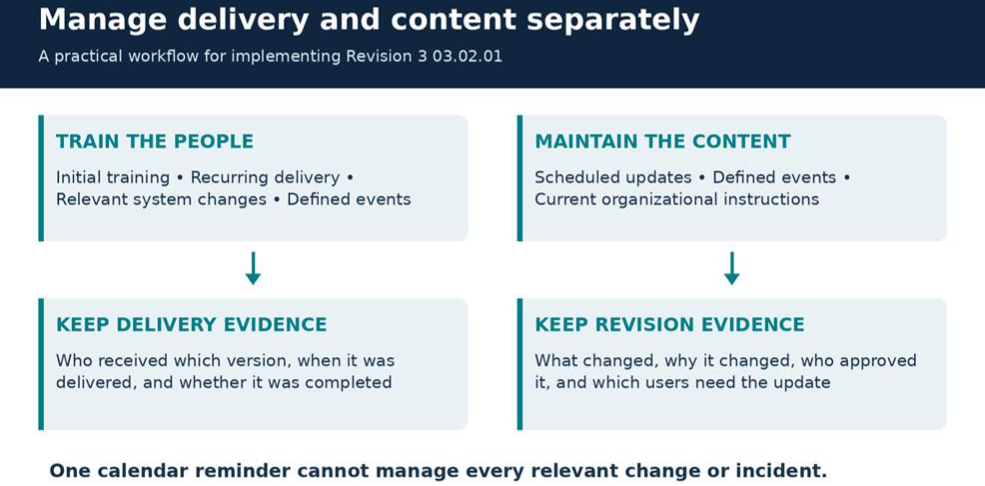
Figure 2. Training delivery and content maintenance have distinct schedules and triggers. The workflow shown is an implementation approach, not a prescribed NIST process.
A company could retrain employees on schedule while continuing to use outdated reporting instructions. It could also revise a course after an incident without delivering the revision to the affected users. Reviewing delivery and maintenance separately helps expose both problems.
For implementation planning, assign responsibility for each decision. Someone needs to identify an event, evaluate its training implications, approve any revised material, determine the audience, and confirm delivery. In a smaller contractor, one person may perform several of these tasks. The process can remain simple while making ownership clear.
Apply the appropriate parameter values
The NIST publication contains parameter placeholders. Organizations should check whether the relevant federal agency has supplied values before making their own assignments.
The DoD memorandum dated April 10, 2025 supplies Revision 3 values for this requirement. It sets both recurring training and content updates at least every 12 months. For both event parameters, it identifies significant, novel incidents, or significant changes to risks. The memorandum defines significant as having or likely to have influence or effect.
Table 1 connects those values to the assessment identifiers. The wording in the last column is a summary; use the source memorandum when establishing the authoritative parameter record.
Table 1. Revision 3 literacy-training parameters and DoD values
| Assessment parameter | Subject | DoD value summary |
| A.03.02.01.ODP[01] | Recurring user training | At least every 12 months |
| A.03.02.01.ODP[02] | Events requiring user training | Significant or novel incidents, or significant changes to risks |
| A.03.02.01.ODP[03] | Training-content updates | At least every 12 months |
| A.03.02.01.ODP[04] | Events requiring content updates | Significant or novel incidents, or significant changes to risks |
NIST allows nonfederal organizations to establish organization-defined parameter values when the responsible federal agency has not specified them; this can apply to organizations outside the DIB, depending on their governing requirements. Once an agency specifies a value, it becomes part of the requirement.
For DIB organizations subject to DoD’s Revision 3 requirements, DoD has published its parameter values, and the memorandum provides no general permission for contractors to substitute their own. Organizations should document the applicable DoD values and their implementation; additional training may supplement those requirements without changing the prescribed parameters.
Make social mining understandable
NIST describes social engineering as deception intended to obtain information or induce an action that can compromise a system. Social mining concerns gathering organizational information that could support future attacks.
For a DIB audience, a useful hypothetical example is an unfamiliar professional contact asking an engineer about project staffing, collaboration tools, travel schedules, and who approves urgent access requests. Each question may appear ordinary. Taken together, the answers could help someone construct a convincing impersonation attempt.
A second scenario could involve a caller who already knows a project manager’s name and claims to need an urgent reset for a colleague. The exercise can show how previously gathered information makes a deceptive request sound credible.
Teach employees to verify requests through approved channels, limit disclosure according to organizational policy, and report concerning approaches. Use examples that fit recruiting, conferences, supplier interactions, remote support, and professional networking. Avoid suggesting that every unfamiliar contact is malicious.
Figure 3 gives course developers a useful review matrix: for each subject, the lesson should explain both what a person might notice and how that person should respond.
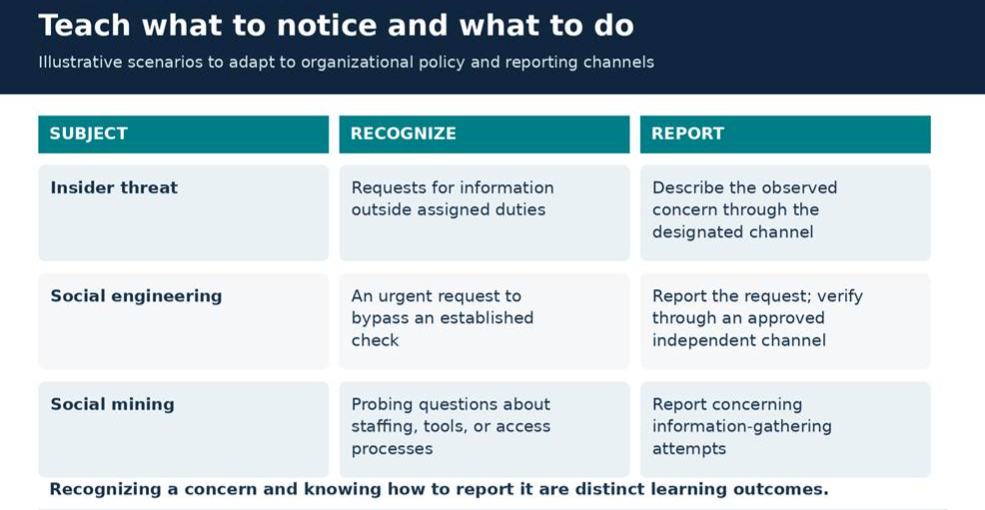
Figure 3. Recognition and reporting are separate learning outcomes. The examples are illustrative and should be adapted to the organization.
Look beyond a completion certificate
The Revision 2 assessment objectives for 3.2.1 address identifying relevant risks and security documentation, then making managers, administrators, and users aware of them. For 3.2.3, they address identifying potential insider-threat indicators and providing recognition and reporting training to managers and employees.
The Revision 3 assessment procedure makes the review more granular. It contains four parameter determination statements and eleven implementation determination statements for 03.02.01. Those implementation statements cover delivery, recognition and reporting across the three subjects, and content updates. These are components of one requirement, not fifteen separate security requirements.
For practical evidence planning, a completion certificate can help show participation, but may say little about the course version, covered topics, or organizational reporting instructions. Pair completion information with the actual material used.
A manageable evidence set might include the approved curriculum, version history, audience roster, delivery records, applicable parameter record, and records explaining training or content changes after relevant events. This is a suggested approach to organizing evidence, rather than a mandatory document list or a prescribed retention period.
For example, a course register could identify a module version and link to the corresponding slides. A training record could then associate each participant with that version and its completion date. An event record could explain why an additional briefing was issued and who received it. Those connections make the program easier to operate and review.
A practical transition for a smaller contractor
Consider a hypothetical 60-person manufacturer with a commercial awareness course and an internally developed insider-threat presentation. The company wants to improve Revision 3 readiness while maintaining its applicable Revision 2 obligations.
Its first task is to inventory existing material. The reviewer identifies where organizational risks, handling rules, insider-threat indicators, and reporting instructions already appear. Material that remains accurate is retained. A generic reporting slide is replaced with the company’s actual process, and a short social-mining scenario is added.
Next, the company connects training decisions to work it already performs. Its change-review process asks whether a planned system change alters what users need to know. Its incident closeout asks whether the event calls for additional training or a content revision. These questions help turn a calendar-driven course into a program that responds to operational changes.
The company then tests the process with a fictional supplier-impersonation incident. The exercise follows the event from identification through the decision to revise a lesson, approval of the change, delivery to the affected audience, and completion tracking. Any missed handoff becomes an improvement item.
Finally, it asks a small sample of users to explain how they would handle a suspicious request. These conversations can reveal unclear instructions even when everyone completed the course. They are useful internal checks, without guaranteeing any particular assessment outcome.
Organize the work into manageable steps
Map existing coverage. Create a short crosswalk from Revision 2 3.2.1 and 3.2.3 to Revision 3 03.02.01. Identify the course, lesson, procedure, and evidence that support each area. Keep the role-based training review visible as a related task.
Resolve the parameters. Confirm the governing source and applicable values. Translate event language into a process that staff can apply consistently. Identify who decides whether an event requires action and where that decision is recorded.
Close specific content gaps. Review social mining, reporting instructions, new-user delivery, and the treatment of relevant system changes. Check that managers, technical staff, and other users receive material appropriate to their work.
Exercise the workflow. Walk through a new-user case, a recurring-training case, a system change, and a relevant incident. Confirm that delivery and content maintenance each reach a documented conclusion.
Verify readiness honestly. Record incomplete work with an owner and target date. Describe planned activities as planned until they operate. Update the system security plan and supporting procedures to reflect actual implementation, rather than a future design.
Organizations should also examine their training-provider arrangements. Determine who controls the curriculum, how quickly material can be revised, whether organizational supplements are supported, and whether records identify the version delivered. A provider can handle course delivery while the contractor retains responsibility for making the content relevant to its environment.
Prepare without assuming the contractual baseline changed
NIST publication status and contractual applicability are different questions. The CMMC model in 32 CFR 170.14 identifies Revision 2 as the Level 2 requirements baseline. Publication of Revision 3 does not, by itself, change that incorporated baseline.
Before changing assessment plans or compliance representations, confirm the applicable contract, solicitation, agency direction, and current program requirements. Treat the comparison in this article as transition planning rather than an announcement of a universal Revision 3 deadline.
Maintaining a crosswalk can support that approach. The organization can continue to demonstrate applicable Revision 2 coverage while recording how improvements support Revision 3 readiness. This also helps avoid deleting useful insider-threat material simply because its old standalone number disappears.
The most useful transition starts with the training people already receive and follows it into their daily work. Keep the material that helps them make sound decisions. Update the instructions that no longer match the environment. Give relevant changes and incidents a dependable route into the curriculum, and verify that affected users receive the resulting training.
For DIB organizations, that work can make the revision shift more manageable while improving the usefulness of the program they operate today.
Sources
1. NIST SP 800-171 Revision 2, sections 3.2.1 and 3.2.3. https://doi.org/10.6028/NIST.SP.800-171r2
2. NIST SP 800-171 Revision 3, sections 03.02.01 through 03.02.03 and organization-defined parameter guidance. https://doi.org/10.6028/NIST.SP.800-171r3
3. NIST SP 800-171A, June 2018, assessment procedures 3.2.1 and 3.2.3. https://doi.org/10.6028/NIST.SP.800-171A
4. NIST SP 800-171A Revision 3, assessment procedure 03.02.01. https://doi.org/10.6028/NIST.SP.800-171Ar3
5. DoD CIO memorandum, Department of Defense Organization-Defined Parameters for NIST SP 800-171 Revision 3, April 10, 2025, Attachment A, Awareness and Training. https://dodcio.defense.gov/Portals/0/Documents/CMMC/OrgDefinedParmsNISTSP800-171.pdf
6. 32 CFR 170.14, CMMC Model, particularly paragraph (c)(3). https://www.ecfr.gov/current/title-32/subtitle-A/chapter-I/subchapter-D/part-170/section-170.14